

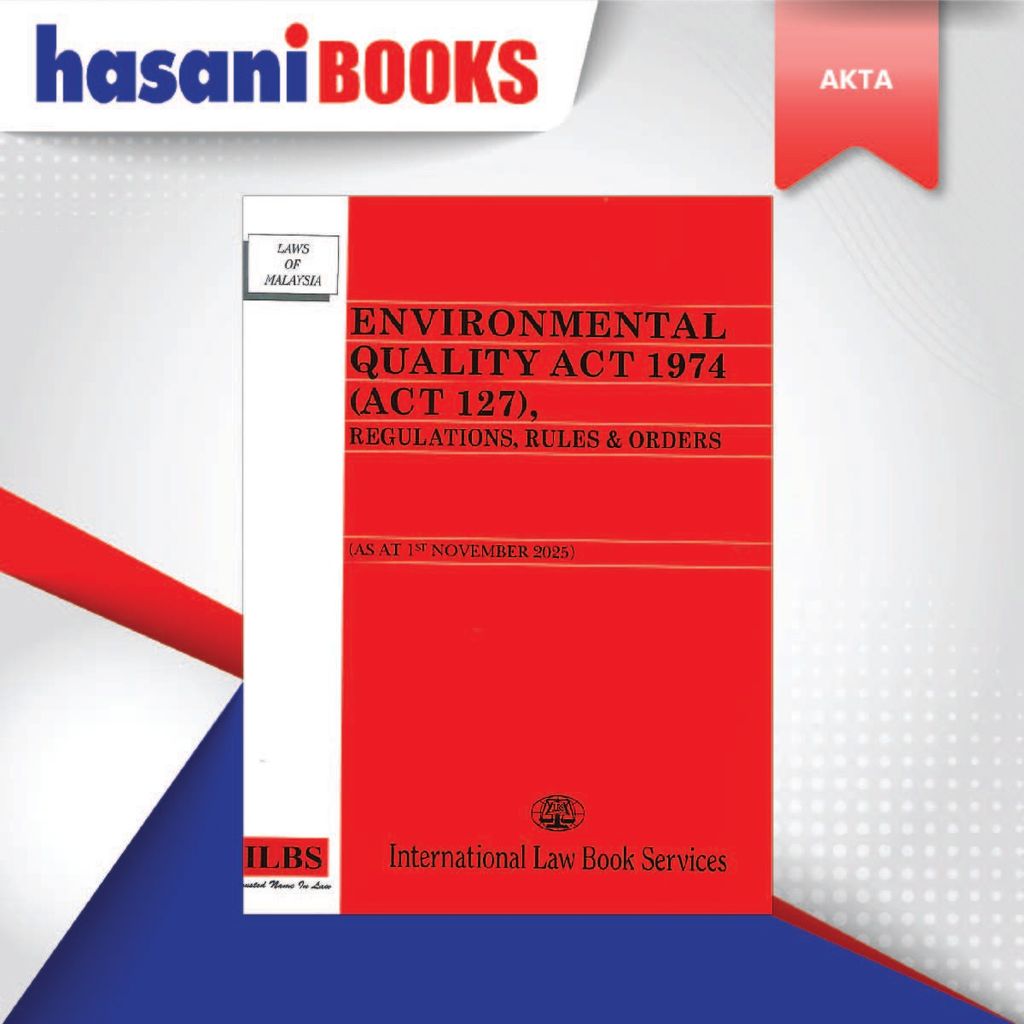
AKTA : ENVIROMENTAL QUALITY ACT 1974 (ACT 127), REGULATION , RULES & ORDERS 1ST NOVEMBER 2025 - ILBS
- Regular price
- RM 45.00
- Sale price
- RM 45.00
- Regular price
-
RM 0.00

Secure payments

Authentic products
Share
The Environmental Quality Act 1974 (Act 127) is a law enacted by the Malaysian government to protect and enhance the quality of the environment in Malaysia. The act provides for the establishment of a regulatory framework to control and manage pollution and other forms of environmental degradation.
The act has been amended several times over the years, and various regulations, rules, and orders have been issued to support its implementation. As of 5th January 2022, the following regulations, rules, and orders are in force:
- Environmental Quality (Prescribed Activities) (Environmental Impact Assessment) Order 1987 - This order requires certain activities to undergo an environmental impact assessment (EIA) before they can be carried out. The activities that require an EIA include projects that are likely to have significant environmental impacts such as large-scale development projects, industrial activities, and waste management facilities.
- Environmental Quality (Clean Air) Regulations 2014 - These regulations provide for the control of air pollution in Malaysia. The regulations set out emission limits for various pollutants, and require industries to install and maintain pollution control equipment to ensure compliance with the prescribed limits.
- Environmental Quality (Sewage and Industrial Effluent) Regulations 2009 - These regulations provide for the control of sewage and industrial effluent discharges into water bodies in Malaysia. The regulations set out effluent standards and require industries to obtain permits before discharging effluent into water bodies.
- Environmental Quality (Scheduled Wastes) Regulations 2005 - These regulations provide for the proper management and disposal of scheduled wastes in Malaysia. The regulations require generators of scheduled wastes to classify, label, and package the waste before it is transported to a designated facility for disposal.
- Environmental Quality (Control of Lead at Workplaces) Regulations 2000 - These regulations provide for the control of lead exposure in workplaces in Malaysia. The regulations set out permissible exposure limits for lead and require employers to implement measures to protect their workers from exposure to lead.
- Environmental Quality (Control of Pollution from Solid Waste Transfer Stations and Landfills) Regulations 2009 - These regulations provide for the control of pollution from solid waste transfer stations and landfills in Malaysia. The regulations require operators of these facilities to obtain permits, and set out requirements for the construction, operation, and closure of the facilities.
- Environmental Quality (Prohibition of Use of Chlorofluorocarbons) Regulations 2001 - These regulations prohibit the import, export, manufacture, and use of chlorofluorocarbons (CFCs) in Malaysia. CFCs are harmful to the ozone layer and contribute to climate change.
- Environmental Quality (Control of Noise at Workplaces) Regulations 2019 - These regulations provide for the control of noise exposure in workplaces in Malaysia. The regulations set out permissible exposure limits for noise and require employers to implement measures to protect their workers from exposure to excessive noise.
Overall, these regulations, rules, and orders play an important role in ensuring the protection and preservation of Malaysia's environment for future generations.